lll (2025)
AUT 2025 / 17min
Language: German (with English Subtitles)
Starring Albert Farkas
Director, Camera & Concept: Josephine Ahnelt
Editing: Anna Kirst
Sounddesign: Wolf-Maximilian Liebich
Originalformat: HD Digital & super8
Sreeningformat: HD-Digital
Realised with Funding by bmkös & MA7 stadt wien
Distributed by sixpack film
Best Documentary Short at Diagonale 2025
- Festival of Austrian Film
Jury Statement:
Speaking about illness – especially one’s own, and even more so an illness as severe as mantle cell lymphoma – requires a high level of trust between the affected person and their interlocutor. In artistic work, it carries a great responsibility. Filmmaker Josephine Ahnelt meets this challenge with impressively precise filmmaking. Coming from analog film, Ahnelt selects her film formats according to the narrative necessities and possibilities, blending precisely framed film shots with video fragments and selfies of the protagonist. The different materials come together in an enlightening and exact way to form a larger cinematic narrative.
The empathy and camaraderie that the director builds with her protagonist throughout the film make this work a great gift. Albert Farkas is a disarming and ruthlessly humorous protagonist whose reflection goes beyond his own illness story. The film also poses questions about the connection between illness, transgenerational trauma, and how this is dealt with within a circle of friends.
In doing so, the film succeeds in capturing the profound thoughts of the protagonist and transforming them into an open, hope-inspiring cinematic narrative, making it a cinematic stroke of luck!
Regina Schlagnitweit for sixpack film Catalogue:
“How bad can a disease like Mantelzelllymphom, mantle cell lymphoma, be,
if it has three consecutive l’s in its name?
Isn’t that the ultimate morphological expression of comfort?
For example, and I quote from the dictionary,
Baumwolllaken (cotton sheet), Bestellliste (order list), Gemüsestillleben (vegetable still life),
Helllila (light purple), Rollladen (roller shutter), Gerölllawine (debris flow).
All beautiful words with happy associations.”
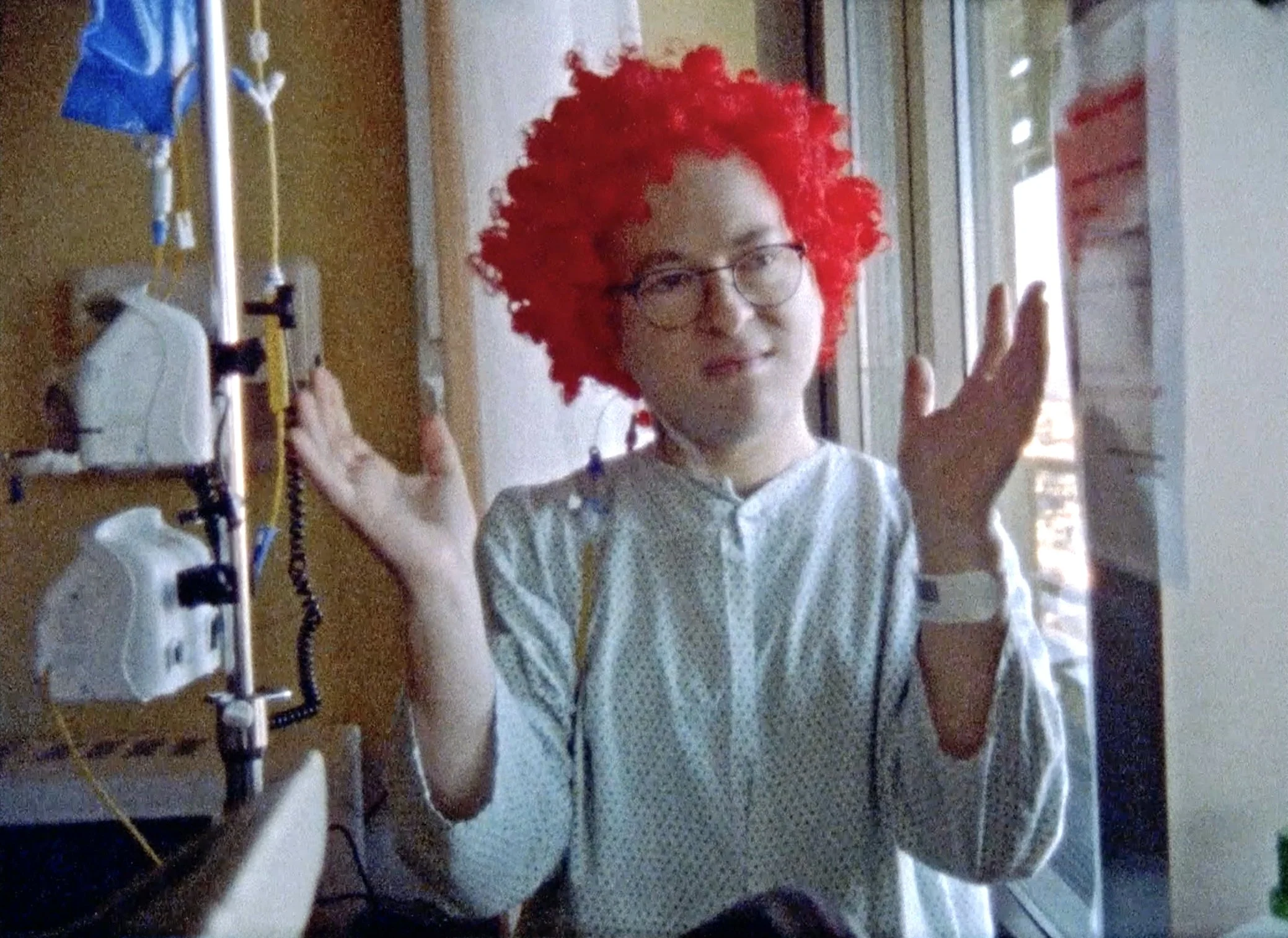
Albert Farkas, the man portrayed here, is in no way inferior to his earlier namesake Karl Farkas when it comes to pitch-black Jewish humor, or more precisely, making jokes about things that are not necessarily funny. And he has found a filmmaking friend in Josephine Ahnelt, who accompanies Albert with a lot of heart and a keen eye and ear while he is on his tough journey through the chemotherapy stations. The motif of hair and its temporary loss runs through the film – for example, during infusions in Vienna’s General Hospital, when Albert wears a red clown wig.
The initial diagnosis is devastating, but the search for life-affirming energy is strong. The film formats vary, from Super 8 to cellphone recordings, and the colors shine differently, just as no two days are the same. The audio track is underpinned by Albert’s reflections – and by birdsong. Right at the beginning, Albert describes a nocturnal awakening from a nightmare that made him, almost in a frenzy, buy containers for feeding birds and yet ask himself whether he would still be around to enjoy them in six months’ time.
We see precious snapshots of a life, ice skating in black and white, a therapeutic session. Albert talks about his hoarding food with gusto, while showing his overflowing cupboards. From his smartphone, he sends snapshots from his travels: Albert with the same serious look, whether in front of the Mona Lisa in the Louvre, in front of the Sleeping Beauty Castle in Disneyland Paris, or at an amusement park ...
At the end, in the Circus and Clown Museum, you can hear Nat King Cole’s rendition of the Charlie Chaplin song “Smile”. And you’ll want to give Albert asphodels, a perennial plant with thick roots and richly branched panicles in the form of white star-shaped flowers with a red line running through the center – since after all, the name in German, Aphodilllilien, contains three consecutive l’s. -